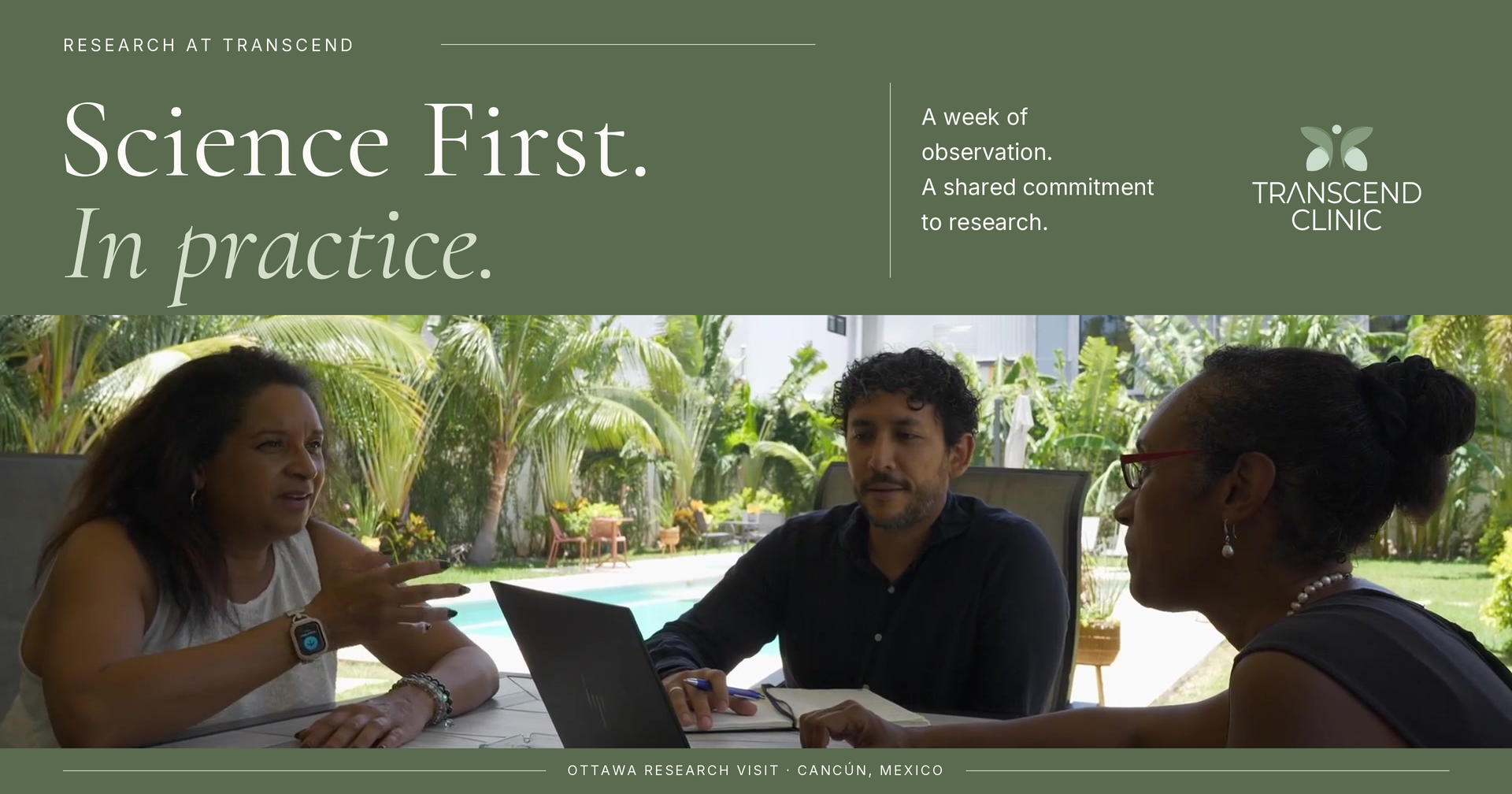
Any clinic can say it puts safety first. We wanted outside researchers to look for themselves. This fall, a team from the University of Ottawa spent a full week on site at Transcend Clinic in Cancún, and we have asked them to keep working with us on our patient data.
As mentioned on USA Today, the visit was announced in our October press release. This post explains what the team saw, why we invited them and what comes next.
Who visited Transcend Clinic in Cancún
The team included Dr. Monnica Williams, Canada Research Chair in Mental Health Innovation and Equity at the University of Ottawa, along with Dr. Sonya Faber and Sergio Pérez Rosal. They are independent of Transcend. They came to watch how we actually work at our clinic in Cancún, not to hear a presentation.
What the researchers observed at our ibogaine clinic in Mexico
The team spent their time where the care happens. They watched three parts of our work closely:
- Medical screening. Every prospective patient is medically screened before we accept them, as part of our intake process. Our medical director personally approves or declines each person.
- Patient supervision. Accepted patients have 24/7 on-site medical supervision for their whole stay.
- Our full mental health team. The researchers saw our clinical team at work, which draws on emergency medicine, critical care, cardiology and psychiatry.
How we approach safety
Every patient is screened by our physicians before treatment is confirmed. On arrival, screening includes a 12-lead electrocardiogram (ECG) and comprehensive blood and urine tests. Our cardiologist on staff gives final clearance after reviewing these results and completing a cardiovascular assessment. Accepted patients have 24/7 on-site medical supervision for their whole stay.
If you are comparing clinics, ask each one what is checked, who checks it and whether anyone outside the clinic has looked.
What the joint ibogaine research will look at
After the visit, we invited the Ottawa team to study our patient data together with us. Our CEO, Jorge Medina, put it simply: "We opened our doors to independent researchers because safety claims should be tested, not just stated. We want our data to help every patient, not only ours." The team is studying protocols aimed at increasing benefit and reducing risk. The work also aims to turn our day to day practice into protocols that others in the field can study and use. That work is just starting, and we are not reporting any findings here. For background on where this field has come from, see our post on the history of ibogaine research.
Watch the University of Ottawa visit
We recorded parts of the week. Watch the research visit video on YouTube.
Important information
Ibogaine is not an FDA-approved medication, and it is a Schedule I substance in the United States. Nothing in this post is medical advice. Every prospective patient is medically screened, and our team may decide that treatment is not appropriate.
This post is adapted from our press release, "University of Ottawa Researchers Spend a Week Inside Cancún's Transcend Clinic to Study What Makes Its Care Safe." Read the original release on USA Today.